<?xml version="1.0" encoding="utf-8"?><feed xmlns="http://www.w3.org/2005/Atom" ><generator uri="https://jekyllrb.com/" version="3.10.0">Jekyll</generator><link href="https://aricin8970.github.io//feed.xml" rel="self" type="application/atom+xml" /><link href="https://aricin8970.github.io//" rel="alternate" type="text/html" /><updated>2026-04-10T12:29:12+00:00</updated><id>https://aricin8970.github.io//feed.xml</id><title type="html">Aricin’s portfolio</title><subtitle>Write an awesome description for your new site here. You can edit this line in _config.yml. It will appear in your document head meta (for Google search results) and in your feed.xml site description.</subtitle><entry><title type="html">The Social Determinants of Health and Capabilities</title><link href="https://aricin8970.github.io//2026/02/19/TSDoFaC.html" rel="alternate" type="text/html" title="The Social Determinants of Health and Capabilities" /><published>2026-02-19T00:00:00+00:00</published><updated>2026-02-19T00:00:00+00:00</updated><id>https://aricin8970.github.io//2026/02/19/TSDoFaC</id><content type="html" xml:base="https://aricin8970.github.io//2026/02/19/TSDoFaC.html"><![CDATA[<p>The <strong>Social Determinants of Health</strong> (SDOH) are self explanatory. How healthy you are is not solely based on medical factors like genetics but on many social and economic factors. In the world we live in it’s entirely possible that something as simple as a zip code can be a better predictor of your health than genetic code. This is possible because our environment is what shapes the chances we get and the opportunities we receive. Paying attention to the SDOH can provide more insight into the health and wellbeing of people and a country, telling us the how and why behind certain health outcomes.</p>

<p>This ties neatly into <strong>Amartya Sen’s</strong> <em>Capabilities Approach</em> (CA) which states that economical numbers like GDP and utility aren’t enough to determine a good society. Instead, we should also be able to look at what humans in said economy are able to do and be. It’s a well known and studied phenomenon that happiness and depression can contribute to health outcomes and being able to move about freely, being well nourished, being able to do things with the life you have are all things that can tie into how healthy you are in the long run. <strong>Martha Nussbaum</strong> expanded on this by giving a practical list of 10 “Central Human Capabilities” (bodily health, practical reason, etc) that governments should be able to guarantee. If everyone in a society is above the threshold of these 10 capabilities then the government is doing its job.</p>

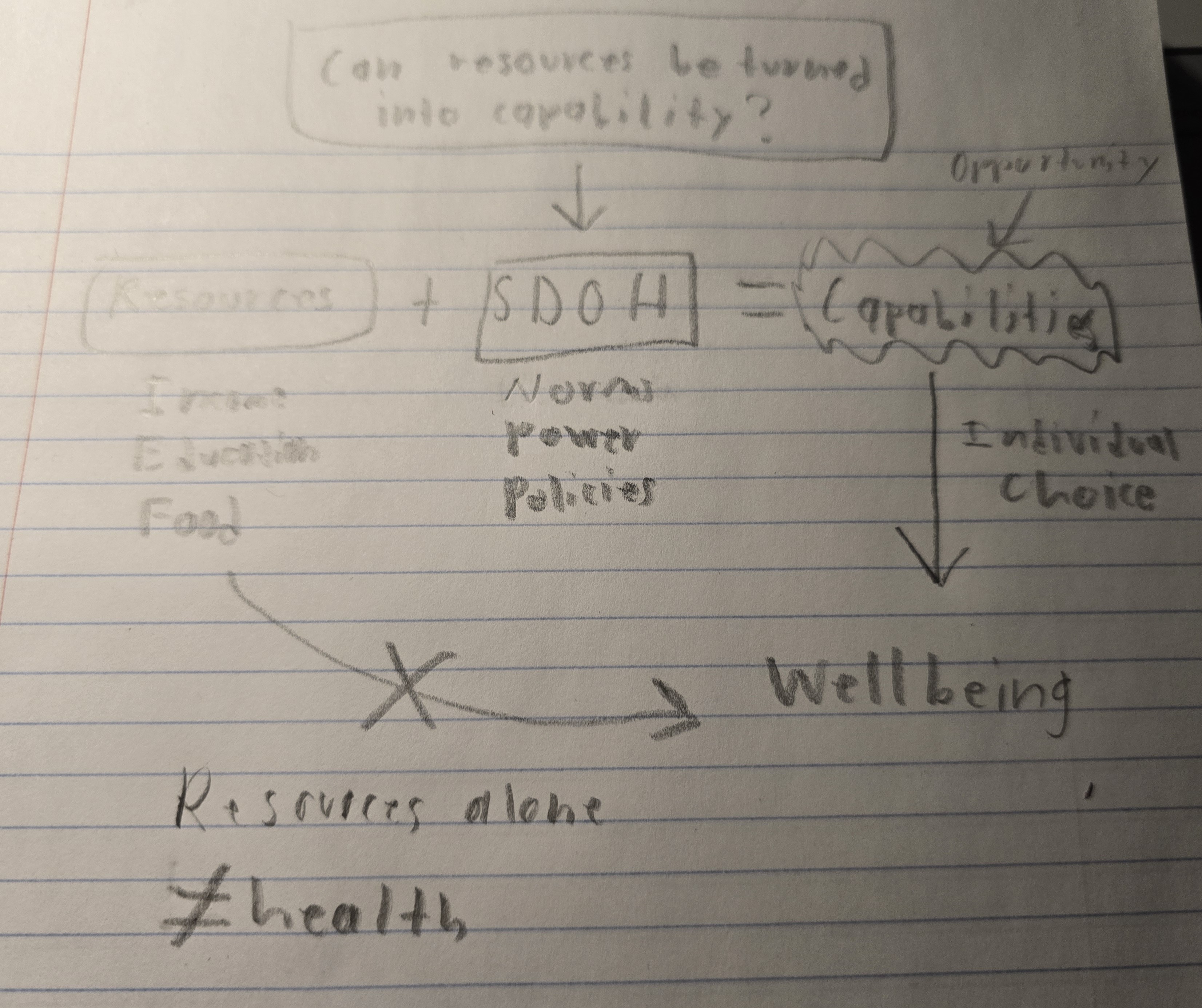
<p>This is the importance of the CA working in tandem with the SDOH. Even with a lot of money (resources) a person’s capabilities can still be restricted if there’s no grocery store (an SDOH) for miles. In public health there’s always the argument between choice and opportunity but even with all the resources, if you have to work two jobs all day long then they can still lack the capability of bodily health even if they know its importance. It’s not a choice, but a lack of opportunity. One could even say they wouldn’t have the freedom to choose health due to a lack of capability. Only when we are aware and actively working for good social determinants of health can resources be turned into capabilities. It’s in those capablities that oppurtunity lies and after that, individual choice and well being.</p>

<p><img src="/assets/images/20260219_220048.jpg" alt="Description of image" /></p>]]></content><author><name></name></author><summary type="html"><![CDATA[The Social Determinants of Health (SDOH) are self explanatory. How healthy you are is not solely based on medical factors like genetics but on many social and economic factors. In the world we live in it’s entirely possible that something as simple as a zip code can be a better predictor of your health than genetic code. This is possible because our environment is what shapes the chances we get and the opportunities we receive. Paying attention to the SDOH can provide more insight into the health and wellbeing of people and a country, telling us the how and why behind certain health outcomes.]]></summary></entry><entry><title type="html">Introductory Reflection: Data Science in Social Contexts</title><link href="https://aricin8970.github.io//jekyll/update/2026/01/16/welcome-to-jekyll.html" rel="alternate" type="text/html" title="Introductory Reflection: Data Science in Social Contexts" /><published>2026-01-16T00:00:00+00:00</published><updated>2026-01-16T00:00:00+00:00</updated><id>https://aricin8970.github.io//jekyll/update/2026/01/16/welcome-to-jekyll</id><content type="html" xml:base="https://aricin8970.github.io//jekyll/update/2026/01/16/welcome-to-jekyll.html"><![CDATA[<hr />
<p>layout: post</p>

<hr />

<p>Data Science has been something I’ve wanted to do since high school. I’ve always enjoyed coding and knew that whatever I did had to deal with that, but when I first heard about Data Science as a job I didn’t know exactly what it entailed. I viewed it as just a cool and practical application of coding, something I’ve always been interested in.</p>

<p>It wasn’t until I started college classes that I started to recognize the importance of ethics and the social impact that Data can have on people. It sounds almost like common sense that there are people at the end of the numbers, that it’s not just ones and zeros but oftentimes people in comfortable positions can forget that. When handling data it becomes exceedingly important that we remember the human aspect, handling data responsibility, taking account of privacy concerns, bias, the chance the data could be wrong, incorrect, or missing something etc. Data Science is about solving problems and providing actionable insights but it should never come at the cost of real ethical concerns.</p>

<p>With this in mind, I have more insight into the direction I want to go. Learning about this side of Data Science made me more conscientious of where my data is coming from, what I’m doing with it, and what the data is missing or just not showing. What’s done with data collected can have a really positive but also incredibly negative effect on populations of people depending on how it’s used.</p>

<p>Ultimately I aim to build my skills in python and other tools for the benefit of others. Modeling populations because understanding trends and behaviors in humans can be used to inform political policies, social programs and a lot more. This portfolio is a way to showcase my growth in the technical aspect, and with the blogs I would like to explore ethical guidelines and considerations. Thank you for reading.</p>]]></content><author><name></name></author><category term="jekyll" /><category term="update" /><summary type="html"><![CDATA[layout: post]]></summary></entry></feed>